Kansas Queer Politics: Wichita’s Legendary Moment

Image

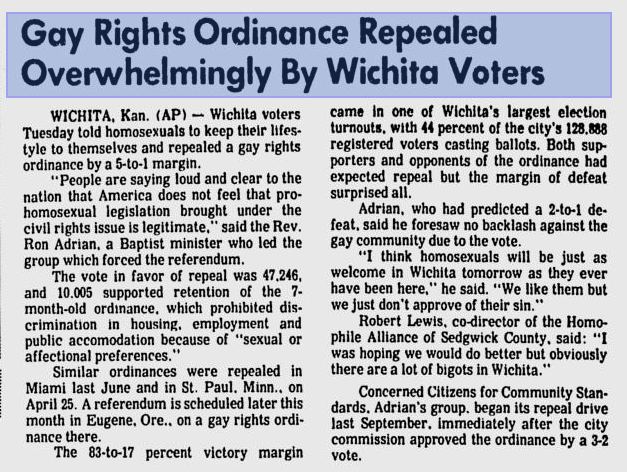
Wichita's civil rights ordinance has never been restored.

Avid readers of this column know that today, you can be fired from your job for being a homo on the range. Many are not aware of a legendary window of time where such was not the case, though. Once upon a time in a land not at all far away, it was illegal to discriminate on the bases of “sexual preference” in housing, employment, and public accommodations in Wichita—for a whopping seven month!

The ICT had a very progressive, forward thinking city commission (now referred to as the city council) in the late 1970’s. In the fall of 1977, Wichita became one of the first cities in the country to enact a non-discrimination ordinance that covered gays, lesbians, and bisexuals. The passage of the law was no accident. Wichita had an engaged and politically savvy LGBT faction that was an active, visible part of the community at-large. They knew how to organize and make things happen. They supported candidates in elections, and they educated lawmakers in office. At the same time Harvey Milk was campaigning to become one of the nation’s first openly gay elected officials by the bay, gay Wichitans were staging a little revolution of their own on the prairie.

When the ordinance was originally passed, many began talking openly about Wichita becoming the San Francisco of the Midwest. That didn’t sit well with everyone, though. Several churches were quick to organize a repeal effort, and within just a few months of the law passing, it was headed to the ballot box. Anita Bryant, apparently tired of sipping orange juice, came to Wichita to crusade for the repeal. The campaign was short, but nasty and personal. On April 9, 1978, all incumbents who voted for the law were defeated, and the ordinance was overturned by a margin of 83%-17%. Of the 57,251 people who showed up to vote, only 10,005 voted to allow gay people to have the same rights as everyone else.

San Francisco, we did not become!  Many people publically identified with backing the law were blacklisted. Several were fired from their jobs or evicted from their apartments. A good number of gay people moved away. Most who stayed either went back into the closet or marginalized themselves. As gays become more visible and involved in other communities across the country, the rainbow faded in Wichita.

Thirty-two years later, the laws haven’t changed, but Wichita has progressed. There have never been more gay people active and visible in all parts of this community as there are today. They’re not just crusading for gay rights, either—they’re opening businesses, revitalizing neighborhoods, and enriching their places of worship. Yet, the sting of Wichita’s “legendary” anti-gay past is still felt. Those who are out, though, are paving the way to a day when a law outlawing discrimination of the basis of sexual orientation (and now gender identity) lasts for more than seven months!
Pride

Image

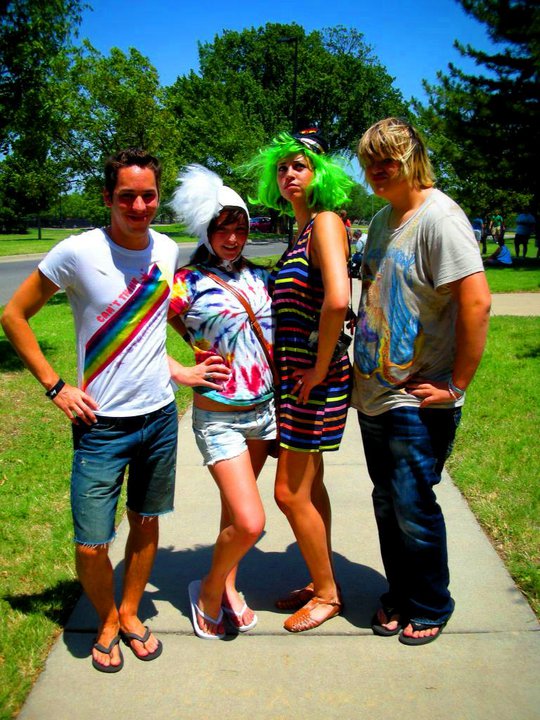
From Wichita Pride.
(photo by David Quick)

Every June, queers around the country gather to celebrate what has become known in the gay community as “Pride”. It’s supposed to be a time for LGBTs in every community to come together to shake away shame and shatter stigmas. However, it’s an event that is often misunderstood and misrepresented.

A lot of straight people just don’t get it. The mere mention of a gay pride parade usually conjures up images of shirtless muscle boys in pink bikinis dancing away to Cher songs while simultaneously grabbing the asses of innocuous hetero-boy passersby.  Fears of greasy, leather-clad lesbians running over women pushing baby strollers also abound. While these hyperbolic stereotypes are slowly fading, even those more in-tune with reality have questions. “Why do gay people need their own parade?” is a question I’m frequently asked. Straight people deserve an answer.

It’s not so much about the parade as it is the principle. Gay people don’t live in a world where their sexual identities are affirmed on a regular basis in the same way that straight people’s sexualities are. Marriage and family are seen by society as a milestone in basic individual human development. Meanwhile, same-sex relationships are often discouraged at best and out-right berated at worst. Most people are assumed to be heterosexual. There’s no “coming out process” involved with admitting that you like a member of the opposite sex.  To have the audacity to say out loud that you dig your own kind, though, takes a certain amount of courage. While we make progress each day, there are still communities where it’s not ok to be gay. Gay bashing incidents are all too common.  There are still people in this city who harbor ignorance or out-right hatred toward homosexuals. It’s legal to get fired from your job in the state of Kansas for being gay. For those individuals brave enough to speak and live their own truth amidst adversity, I say a parade is in order!

Pride really isn’t so much about a parade, though, as it is about a possibility. In Wichita, we’re on the cusp of social change. Our pride celebrations get bigger each year. It’s a testament to the generations before us who envisioned a life outside the closet as possible. I remember marching in the 2002 parade on Main Street and being accompanied by about 40 people. Last year, an estimated 1,200 people took part in the multi-day celebration in Nafsgar Park! This year promises to be even bigger! One exciting event being planned is a screening of the movie Milk at The Orpheum Theatre on June 22nd. I urge you all to come out and watch it. You’ll get a glimpse of what is POSSIBLE for Wichita. In the 1970s, gay San Franciscans united behind the optimistic Harvey Milk because they believed that their community could become relevant and contribute to the city’s development in a positive way. I believe the timing is ripe for the gay community in Wichita to follow suit. It is not outside the realm of possibility that we could elect one of our own to local public office within the next five years.  Doing so would send a much stronger message about what people with obstacles set before them can achieve than any parade ever could.

In the mean time, though, let’s not be shy to celebrate who we are! Let’s not forget, though, that sometimes we have to help our straight friends understand why this is important. We break down barriers by being honest with ourselves about who we are, and by not being ashamed to speak that truth to others. In doing this, we lay tracks for limitless possibilities.