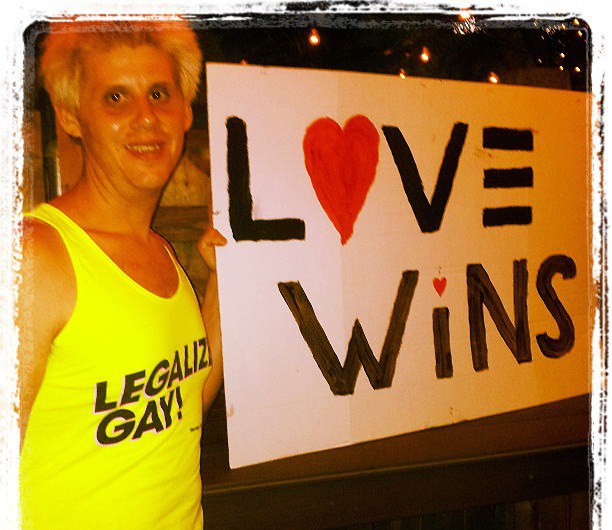
Courthouse Mocks, but Love Wins.

1013393_10100169247693522_310450197_nI moved to Kansas in July of 1999 with my mother and her fiancé. A few weeks later, they were to be married in an outdoor garden ceremony. I don’t recall many of the particulars that surrounded their wedding, but seared into my mind are all of the details regarding their marriage license. I went with my mom to pick it up at the historic courthouse downtown. Once inside, we climbed several stories of stairs to get to the office where it would be processed. As we trekked up those wide, marbled flights, I ruminated on a single thought: I will never be allowed to do this.

That courthouse was mocking me. Seventeen years old, I dreamed incessantly about getting married.  I wanted to share my life with someone and eventually start a family of my own. That vision was more like a fairytale, though, because I wanted to marry a man.

Gay marriage was banned in most states and the ink was still wet on the Defense of Marriage Act. Having sex with another man was a statutory offense in my new home on the range, a “crime against nature.” I knew enough about American history to understand that the scales of justice were titled to eventual equality, but at the time there was no true movement for same-sex marriage. Gay rights were a radioactive topic in most circles. I would be well into my Medicare years before I’d ever be able to legally marry. Or so I thought.

Discrimination affects everyone differently. Most teenagers aren’t as politically conscious as I was. Most gay people don’t let the limits of the law limit their ability to love. Somehow, though, I internalized the climate around me. When we left the courthouse that day, I decided I would give up on the idea of ever getting married, or ever being loved for that matter. What good is a relationship when it isn’t even real, I though to myself. There’s no use in wanting what you can’t have.  I’d go into politics and fight for the rights of others to have what I couldn’t. Somehow that would make up for what I was being denied.

That’s an extreme reaction, I know. It’s likely difficult for most people, even many who are LGBT, to understand why someone so young could get jaded so fast. Inferiority builds up over time. Discriminatory laws foster intolerant societies that ultimately bully the spirit of the people they are oppressing. Do we ever fully comprehend the aftershock of a gross wrong? Everyone who is gay has been affected in some way by the laws that limit our love.

That’s exactly why last month’s ruling by the U.S. Supreme Court striking down the Defense of Marriage Act and allowing a return of same-sex nuptials to California is so epic.  The next generation of gay kids will grow up in a world where their rights are rapidly expanded and their love is openly celebrated. They’ll never have to give up on love because they’ll see it all around them. For people like me—who came of age thinking that marriage and family would be out of reach—there’s a whole new world of possibilities.

When the court handed down their ruling, I was seated at my desk live streaming the text feed of the decision on SCOTUSBlog.com.  As soon as I understood the jest of the opinion, something happened that I was not expecting. The dream I let die a decade and a half earlier at that courthouse was revivified. Optimism had returned, and at the age of 30, I knew that I was destined to be loved. I savor the hope that I will have my own husband and my own family. I look forward to one day marching up the stairs of a courthouse and getting my own true, valid marriage license.

That day hasn’t yet arrived in Kansas, Oklahoma, or Arkansas, but it’s coming! In the meantime, we must stop letting limits on justice mock us. We—and we alone—are love; freedom will only grow when we boldly and openly embrace who we are and whom we were meant to love.
It Matters to Them, Too

Image“How many straight people are glued to their computers on a Friday night waiting to see if they can get married?”

That was the question I sarcastically posed to the Twitterverse as the New York State Senate debated a bill that would legalize marriage for same-sex couples. Late at night, when most people were out celebrating the start of their weekend, myself and about half- a-million other people around the world were at home. We were all streaming the deliberations that would become a milestone in the movement for marriage equality. It turns out that it was not just my homo peers who were eager to celebrate history; many of my straight friends made it clear that the decision was just as important to them.

There is a certain secret to social progress. When a movement matures to the point that its message resonates beyond the mere population it aims to elevate, a watershed moment is reach. One thing became evident when New York passed the bill: gay rights resonate with straight people, too. Equality matters to everyone because it defines the parameters by which we get to form our own, unique selves.

This is true not just in blue state havens, but also here on the ruby-red range. In the Midwest, you have to look beyond legislative bodies to see it, though. Progress is not just measured by political gains; it is often evident at personal points.

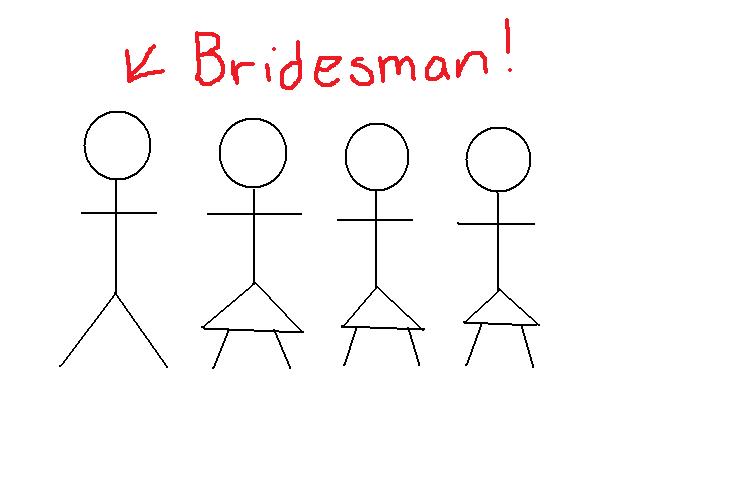
I saw this beautifully illustrated at my friend’s wedding—a heterosexual affair. Like a lot of straight women, one of her best friends is gay. On a normal night out, he would be “one of the girls”, a homosexual who dates men, though a heterosocial who hangs out with the ladies. Weddings being the ultimate gendered occasion, there is no true formality for guys who fall more into the bridesmaid category. On such an important day, though, shouldn’t the seminals of your ceremony reflect the contours of our life? That is what my friend decided, so she made him a bridesman! It was not a political statement about the institution of marriage; it was a personal reflection of interactions in her life.

When it came time for the recessional, interactions intersected into interesting.  As bridesmaids marched down the aisle with hands locked to their color-corresponding groomsmen, a tacit ponder permeated the room. Would the gay bridesman to the far-left lock arms with the last remaining (presumably straight) groomsman on the far-right? The answer was an understated, easy yes! As the two men clasped hands, wedding guests smiled lighthearted and clapped with approval. There was something about the spirit of that collective gesture that signaled more than a mere noise-making formality to end the ceremony. It was a sign of true progress. It was an indication that, gender politics aside, most Kansans just want the people they care about to be happy. There is perhaps no greater joy than having the freedom to celebrate one’s life exactly as it is.

It is likely to be a long time before Kansas joins the list of states where same-sex couples can marry. In the meantime, though, gay rights will continue to resonate on the range. The reason why? It matters when your best friend does not have the same rights as you. As more people come out, more events like this will unfold. All of that will add up to nights like that fateful Friday—when our straight friends are just as concerned about us having equal rights as we are

As Goes Maine

ImageAs goes Maine, so goes the nation.

That’s the political expression dating back to the Franklin D. Roosevelt-era that prophesized a national victory for his 1936 challenger, if only he could clinch the New England state’s electoral votes. Thought to be a bellwether for how the nation was trending as a whole, this idiom turned out to be quite idiotic. Al Landon  secured Maine’s coveted votes that year, only to see Vermont be the lone state to follow suit. Roosevelt went on to win the biggest Democratic Party landslide in history. As went Maine, so went pretty much nothing else.

But as goes Maine, so goes gay marriage?

As supporters of marriage equality find themselves in the familiar place of reeling after yet another electoral set-back, that’s a story worth remembering. Like a lot of people, I hoped that Maine would live up to its Latin motto Dirigo and establish itself as the leader for where this country is headed on the issues of diversity and inclusion. After stinging defeats at the polls in 30 states, I thought we were on the cusp of breaking the trend. I was ready for a night of celebrating. I reveled in the opportunity to live history. Initial results showed the repeal of the new marriage law trailing. I ordered a martini at my favorite local bar and was prepared to toast victory the minute it was announced. As the night wore on and the refresh button of my internet browser loaded up less than promising numbers with each click, I was feeling a hang-over before I could even take a sip.

The Pine Tree State had one last chance to get it right before the decade known as the 2000’s came to a close. One year to the day that California voters overturned gay marriage with Proposition 8, though, Mainers narrowly elected for the status quo. Their vote closed the door on history books recording this decade as the one when people embraced fairness.

My mind went back to re-live the scene that unfolded on the same night in 2008. Barack Obama had just been elected President of the United States. Jubilation and mirth permeated the grand Murdock Theatre where hundreds of Wichitans gathered to celebrate as they watched history unfold on the big screen.  Barack, Michelle, Sasha, and Malia took the stage, and as they did, a dream was realized and a giant wall crumbled. Tears of joy formed an ocean that washed it away; a moment was created that forever changed the national psyche for what is possible. I held the hand of one of my best and oldest friends as we watched from the balcony above the crowd. Herself the ancestor of slaves, this was the moment Bronwen had waited for—the moment when possibility matured into reality and the moment personal barriers began to fade. We clung tightly to each other, and we let history take control of us as we cried.

Within a matter of minutes, though, those tears of joy became tears of sorrow for me. I was alerted via text message that Proposition 8 was headed for passage in California. Gay weddings, which had been legal for nearly half a year, would cease the next morning. When Obama delivered his victory speech, one side of my face cried in joy; the other side cried in grief. It was the picture of irony on that majestic balcony when my hand intertwined with Bronwen, who herself has always been a vocal supporter of equality.  As one dream was realized, another was taken away.

Since that night, I’ve wanted my own moment to claim. I was hoping that Maine could give that to the gay community. After seeing the results of this and other recent elections, though, I think it’s reasonable to assume that we’re about five years away from any state affirming our rights at the ballot box. We’ve come a long way in a short amount of time, but we still have a few more steps to travel. Though it’s of little comfort in moments like this, the fact that 47-48% of a state can vote in favor of gay marriage after this really only being a true political/social for about a decade is quite remarkable. I remember the days when civil unions almost caused civil war in Vermont. Now, many conservatives are clamoring for the opportunity to support such measures as an alternative to full marriage equality. We WILL have our moment, but we need to think about what the moment is going to look like.

The day that the first state votes to affirm the rights of same-sex couples to marry will be the day that the first domino in a deck stacked wide against equality will fall. It will be the culmination of a culture transformed by a new generation taking ownership and an older generation opening up their minds. Already, we see shades of this as the margins of these ballot defeats narrow.

The Millenniums, virtually all of whom grew up with gay friends, will become more engrained in their communities and take ownership of them through the ballot box with each passing year. Generation X and The Baby Boomers, many of whom are uncomfortable with homosexuality, have their minds opened each day as family members and friends come out of the closet. Amidst talk of older generations needing to die off before equality can be realized is the silver-lining that silver-haired grandparents often re-evaluate their own feelings after they discover a beloved grandchild is gay. We’ve got a bit more educating to do. More of us have to come out and more of us have to have conversations with people about our lives. More of us have to become forces within our churches, workplaces, and communities. People have to be ready to accept us before the rights we’re working so hard to gain will be set in stone. This will all manifest itself one day soon at the polls. That first domino WILL fall. When it does, the rest will follow fast.

No one should have to spend a restless night running back and forth to a computer in the wee-hours of the morning to check election returns to see if they have the same rights as other people. The pain these ballot measures cause in states half a coast is real. Palpable emotions ensued in all corners of the country as voters in a tiny state took away a moment so many of us hoped for.

But just like Maine failed to be a bellwether for the Landon for President campaign in 1936, so too has it fallen short of being a predictor for the national movement for marriage equality. No one state—or 31 states for that matter—can change the momentum that comes with each passing day. Those of us who are reeling today would do well to double our efforts to stand out and make a difference in the communities in which we find ourselves. That is how we change tomorrow.

Our friends in New England may have a great state for lobster, but as far as predicting social and political trends, as goes Maine, so does NOT go the future.