As Goes Maine, So Goes The Dialogue

Image

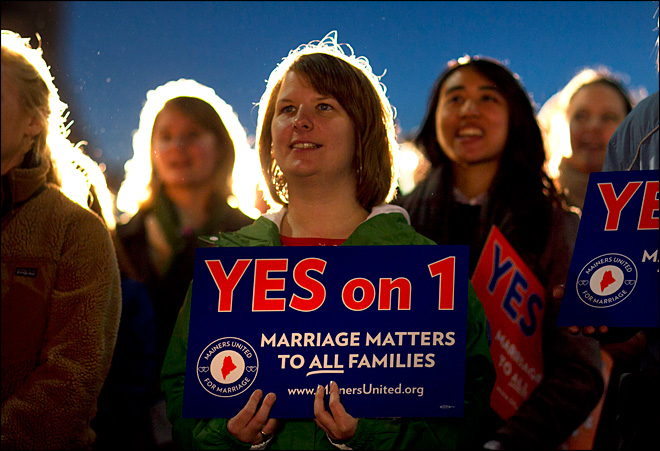
Mainers say “I do” to marriage equality on Nov. 6, 2012

As goes Maine, so goes the nation.

That’s the political expression dating back to the Franklin D. Roosevelt-era that prophesized a national victory for his 1936 challenger, if only he could clinch the New England state’s electoral votes. Thought to be a bellwether for how the nation was trending as a whole, this idiom turned out to be quite idiotic. Al Landon secured Maine’s coveted votes that year, only to see Vermont be the lone state to follow suit. Roosevelt went on to win the biggest Democratic Party landslide in history. As went Maine, so went next to nothing else.

But as goes Maine, so goes marriage equality? Perhaps it’s safer to say this: as goes Maine, so goes the national dialogue.

Three years ago, Mainers said “no” to marriage for same-sex couples. This year, they joined two additional states in saying “I do” when asked to ratify this right at the ballot box. That same night, voters in two Kansas towns had their own proposition. When Hutchinson and Salina were asked if gay people deserved protection from being fired from their job because of their sexual orientation or from being evicted out of their home because of who they are, they said “no”. The reasons why have little to do with red state/blue state schizophrenia. They have everything to do with a basic tenant of democracy: dialogue.

After voters rejected Maine’s gay marriage law in 2009, gay rights organizers shifted focus. Rather than talk about “rights” and “benefits” LGBT folks felt entitled to, the conversation shifted to something much relatable: “love”. It turns out that straight people get a bit confused and rather uncomfortable when we start demanding our civil rights; but when we talk about the universal need of love, we can win over their sympathy. The reason why is simple. Love is something everyone can understand. If you frame the issue as saying “yes” or “no” to someone’s own personal happiness, you sort of look like an asshole voting in the negative.

We’re a long way from joining the nine states that have enacted marriage equality here on the range. Given the current political dynamics in our states, we’re a ways off from basic civil protections, too. What we do have is something quite potent: our voices! When these two small cities in Kansas voted on gay rights this past November, it was the first time either community had ever talked about who LGBT people are. There were LOTS of misconceptions, fears, and stereotypes; but there were also a lot of minds opened up, conversations had, and attitudes changed. When we step out of our comfort zones and start talking about who we are, we let people see our lives. We demystify misconstructions, alleviate anxieties, and tear apart typecasts.

Neither city should have voted the way that they did, but the fact that the pro-equality side garnered 46% in Salina and 42% in Hutchinson is measurable progress. Ten years ago, support would likely have been mired in the low to mid-30% range. The Kansas Equality Coalition, the only statewide LGBT advocacy group, is only 7 years old. The states that legalized marriage equality all have had persistent gay rights movements that date back three of four decades. We’re really just starting the dialogue in Kansas and in many of the surrounding states.

November 6, 2012 was perhaps the best night ever in American LGBT history. Three states legalized marriage equality by popular vote, and voters in one state beat back a proposed ban. The first sitting President to support marriage equality was re-elected. Congresswoman Tammy Baldwin became the first openly gay person to win a seat in the U.S. Senate. Voters sent five openly gay men and an out bisexual woman to Congress. This was the night when “the new normal” ceased to just be a wittily crafted sitcom and started to be how Americans feel about LGBT people.

In that regard, the country is now taking Maine’s lead. We’re going to have to be a bit more patient and a lot more persistent here on the range. But, we will get there. As went Maine on November 6, 2012, so, too, will one day go the entire Midwest—but only with lots of dialogue. So open your mouth and start having those conversations!
Homo on the Range

Image

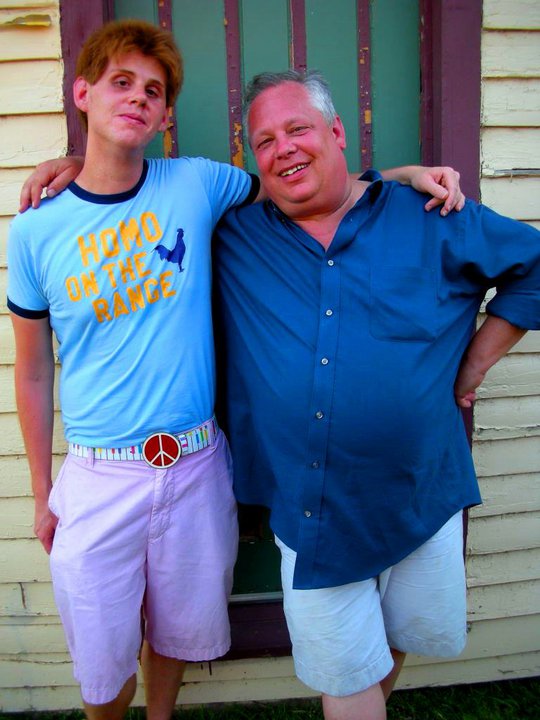
Homos on the Range: Me with Kansas Equality Coalition Executive Director and very good friend Tom Witt.
(photo by David Quick)

Home, home on the range. Where the bis, trans, fags, and dykes play. Where seldom is heard, an intolerant word. And the cities are proud of their gays.

If you think I’m referring to Massachusetts, home of a visible and established gay community where same-sex couples have been legally tying the knot for half a decade, think again! It’s Kansas that is the object of my opining. Perhaps not the Sunflower State we live in today, but the land I believe we will live in soon.  It’s with this vision that I introduce “Homo on the Range”.  An online anthology about queer life in the Midwest, I’ll explore what it means to be gay in Kansas and examine the complexities of being an out homosexual in a time of great regional social change. For decades, gay rights battles have been staged largely on both coasts, with San Francisco being home to the nation’s first gay neighborhood and New York City being the birth place of gay liberation visa vises the Stonewall Riots. Well, Kansas is just as queer as any other spot on this earth, and the moment has arrived for there to be a gay shift in focus to the center of the country.

I love living in Wichita, and I will always have a special affinity for this city because of the way it embraced me. I moved here from North Carolina when I was 17. Recently outed at my southern high school, I lost all my friends and all sense of belonging. I came to Kansas down, depressed, and defeated. Over time, I began to notice that people here were different, though.   Kansans value hard work, self-determination, optimism, and community. Anyone who is willing to roll up their sleeves and work hard for the common good will quickly earn their respect and friendship.  Everything I’ve done in the community—in my education, in politics, and in the arts—I’ve done as an openly gay man. I worked hard to earn the respect of friends, fellow students, teachers, and colleagues. In turn, they came to respect me. For people who knew me, suddenly homosexuality wasn’t much of an issue.

A case in point came immediately after the 2005 constitutional amendment referendum, when 70% of voters voted to ban same-sex marriages and civil unions.  I was director of the local Democratic Party at the time. During one of our meetings, an old farmer from Haysville cornered me. “You’re one of those homosexuals, aren’t you,” he asked straightforwardly.  Unsure of where he was going with this, I timidly replied in the affirmative. “Well, that’s what I’ve heard. And you know what? I voted for your people. I don’t know much about that gay stuff, but I know you, and you’re a good guy. I figured the rest of ‘em can’t be all that bad,” he matter-of-factly stated.  I understood in that moment just how important being out was.

Obviously, we don’t yet live in a state where intolerance toward gays and lesbians is a thing of the past or where cities embrace their LGBT communities. We can, however, make significant progress. If every person in Kansas who is gay was honest about it and made sure their friends, family, and co-workers had a human face to put on an issue that is all too often politicized, I think the marriage amendment battle would have had a different result.  It’s our responsibility to shape the world we want to live in. If you’re reading this and you’re in the closet, come out! Maybe you can’t tell your parents or perhaps you can’t be out at work (it’s still legal for most employers in Kansas to fire someone for being gay!), but everyone has at least one friend they can be honest with.  In Kansas, I’ve learned that the more comfortable you are with yourself, the more people are comfortable with you. Be true to who you are. Decisions about how we live our lives today will set the stage for how others are able to live their lives for the next decade.

Being a homo on the range really isn’t as tough as one might think. We’ve got great people in this city who want their minds opened and horizons expanded. Don’t deny them that opportunity. If you do, you’re denying us all that poetic community I muse about above.  We can accept the status quo, or we can create our own culture. Let’s make Wichita a city that embraces its queer-side!